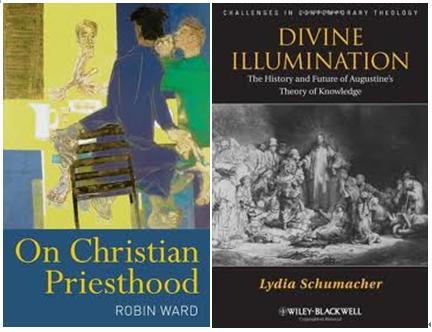
Divine Illumination (Wiley-Blackwell) by Lydia Schumacher
Wednesday 11th May 2011
from 5pm to 7pm at
St. Stephen's House
RSVP
enquiries@ssho.ox.ac.uk 01865 613 500
"Video caelos apertos" (Acts 7:56)
This homily was given by Taemin Oh, a final year ordinand, at Evening Prayer on Monday 14th March 2011;
--
‘Remember that thou art dust, and to dust thou shalt return.’
Last Wednesday, we all received the sign of cross - the symbol of humanity, our sins, our life, and our death. We, as God’s creatures, should be aware of the fact that the last thing we will encounter is death. Regardless of who you are or what you have, all human beings are subject to death and shall return to dust.
Yet, for us, dust does not just mean the end of our life. Rather, dust gives us hope; hope for resurrection, hope for our salvation, and most of all, hope for the world to come, through Jesus Christ. Therefore, Ash Wednesday was not just the day of reminding us of our sins, but the day of desiring the grace of God and reunion with Him.
As our life is always full of ‘comings and goings’ or ‘ups and downs’, my life also has many days to be remembered. As a final year student, part of such rich memories are about to fade away into history. In the next term, all leavers, including me, will be sent out to the world, to serve not to be served, to witness God’s love and to proclaim the Gospel. And soon, God willing, we will be swamped by the huge amount of parish work, and eventually, we will be forgotten from each other’s memories.
However, it may be that we will see each other again soon, and some of us may meet often. We may come back to the House for a Staggers’ reunion, or any other special occasion. However, I am not sure whether we, as a whole, can be in the one place again as we are in this chapel today.
Gerald Charles Perkins.
Edward Stuart Churchill Lennard.
Cyril George Woolley.
William George Herbert Gater.
…
Do you recall anything on hearing these names? Is any one of these names familiar to you?
These names are actually to be found on the walls of this chapel - just right in front of you – all 144 names are carved in the wall. Once, all these people spent some time together here, and once, all became dust.
Yet, I do believe all are now in the full communion with God, and also believe that it will be our true reunion when our names are carved in the wall, in this chapel, side-by-side.
‘Life is short; death is certain; and the world to come is everlasting’ says John Henry Newman.
We are still young (-ish) and still we have many things to do before we become dust. However, as Newman says in one of his Advent sermons, ‘Christ’s coming is ever nearer than it was. O that, as he comes nearer earth, we may approach nearer heaven!’
Day passes after day, silently and we are approaching the end of Hilary term. Therefore, this Lenten period should be the time for us to pray for each other, and ask God’s pardon and mercy be upon ourselves and others, so that we all partake in the glory of heavenly reunion.
Let us pray…
May the God of all love,
who is the source of our affection
for each other formed here,
take our friendships into his keeping,
that they may continue and increase
throughout life and beyond it,
in Jesus Christ our Lord.
Amen.
O God, Who art everywhere present,
look down with thy mercy upon those who are absent from among us.
Give thy holy angels charge over them,
and grant that they may be kept safe in body, soul and spirit,
and presented faultless before the presence of thy glory with exceeding joy;
Through Jesus Christ our Lord.
Amen.
This homily was given by Mark Lyon, a final year ordinand, at Evening Prayer on Monday 7th March 2011;
--
A church service is basically aerobics in slow motion. You have to get up, get down, come forward and turn around, all to background music with a kind of Mr Motivator figure out in front. You even get your own mini-aerobics mat hanging on the chair in front.
While these words are quite comical they nevertheless have an element of truth about them. Within the Catholic Church, the liturgy is designed so that there is air of constant movement and direction; different postures, whether we are on our knees, standing or sitting prepares us for the different parts of our worship. One of my favourite icons – Rublevs Trinity – shows us the importance of movement, while the Father, Son and Holy Spirit are seated somewhat stationary there nevertheless is a movement of activity – the activity of Creation and Redemption. What we do physically thus prepares us for what we must do spiritually. Mind, Body and Soul, while different are nevertheless one.
On Wednesday of this week we enter the very important penitential season of Lent. All of us I’m sure have either decided or thinking about what we are to give up, however, it is important to remember Lent is not a time to deny ourselves as a form of punishment. It is a time when we realign our lives back into the loving relationship with God that he has ordained us to have. The things we give up, therefore, should always have this focus. If we give up something the time or money we save should be put to good purpose. Whether that is time for extra devotion or money to a charity the essential part to this penitential season is to deepen the relationship we have with our Heavenly Father.
Lent is a time when the movement in the Liturgy, must affect and shape the movement of our life. Guy Browning talks of the physical movement in Church services being aerobics in slow motion – Lent is the time for our spiritual aerobics. A time when we exercise our relationship with God to strengthen ourselves so that whatever life throws at us – we have a sure foundation of the Hope, Love and Charity that has been given to us on the Cross.
On Wednesday we begin our journey to Golgotta – we carry our Crosses, in order that they can be transformed by Christ’s forgiving and redemptive love. It is the same love that not only redeems but brings us to the point of redemption. Jesus does not leave us to carry our own Crosses but he carry’s them alongside us. It is his work in, with and through us that enables us to say on our Good Friday his final words – In to your hands I commend my spirit.
The giving up or taking on something for Lent is a painful task but it is a task that we must undertake if we are to experience the joy of the resurrection. By ensuring that we engergise our spiritual lives in this way will enable us to witness to the world, of God’s redeeming and transforming love. In so doing we can just perhaps with true humility utter the finals words of S. Paul from our second reading tonight “And they glorified God because of me.”
Heavenly Father, Alone with none but thee,
I journey on our way;
What need I fear, when thou art near
O King of night and day.
My life I yield to thy decree
And bow to thy control.
Thou art our trust, O King of kings
We make this prayer through Our Lord Jesus Christ who liveth and reigneth with you and the Holy Spirit, one God now and forever. Amen
This homily was given by The Right Reverend Geoffrey Rowell, the Bishop in Europe on the Feast of Edward King on 8th March 2011.
--
Tomorrow morning, as is the way of the Bishop in Europe, I leave for Ljbljana in Slovenia to celebrate Ash Wednesday with our congregation there. I shall then be visiting the Roman Catholic Archbishop and the Lutheran Bishop and will be taking as gifts Professor Grace Davie’s book on religion in Europe amazingly translated into Slovenian! Then it is on to Trieste for another Lenten service and Venice and a meeting with Cardinal Scola, and the First Sunday in Lent with the congregation of St George’s in the morning, and with the Nigerian Congregation of St Anthony Abbott in Padua in the afternoon, before Milan overnight, and then another Lenten service and parish visit in Corfu before getting back here a week later. Knowing that Venice celebrates Cardinal with masks and processions and a whole retinue of pre-Lent customs I had hoped I could have been there today rather than on the first weekend in Lent – but then I should not have been here to celebrate this annual commemoration of Edward King.
It is rare indeed that Edward King’s day coincides, as it does this year, with Shrove Tuesday. Only when Easter is as late as it is – the very latest it can be – is there a chance of these two days coming together; but this year they do.
In the says and places when Lent was more fully observed than it is today, Shrove Tuesday was the time for feasting, for using up the foods which not be permitted during Lenten abstinence. Eggs and fat and dairy produce were made up into rich dishes such as pancakes. The French call today Mardi Gras – ‘fat Tuesday’ – for this very reason. One should note that in the Orthodox world it is possible to have a very good banquet of fasting food, as I once did in the Monastery of Miloseva in Serbia where the table groaned under no less than 22 different dishes of fasting food! But our name for today is Shrove Tuesday, which comes from an old English word schriven or shrive, which in turn may come from the Latin scribere ‘to write’, but which means to make confession. As an old Anglo-Saxon church order puts it: ‘in the week immediately before Lent, everyone should go to his confession and confess his deeds, and his confessor shall so shrive him.’
One of the treasures of Catholic spiritual life and discipline recovered by the Oxford Movement was personal confession of one’s sins to a priest and personal absolution. It was there in the Book of Common Prayer in the order for the Visitation of the Sick, and is mentioned in one of the exhortations before Communion. It never entirely died out in the Church of England, but its use was rare and in extremis, and practice could certainly vary, as an account of a deathbed confession in a celebrated series of Death-bad Scenes from the early nineteenth century, portrays the dying man noiselessly confessing his sins to God, and the absolution being given when it seemed he had ceased.
The revival of auricular confession was a neuralgic point for Protestant controversialists, for whom it smacked of the worst features of priestcraft and Popery, and in particular there was objection to the violation of family life by the priest hearing the confessions of wives. Protestant polemicists caricatured those who resorted to the confessional, as in the verses published in a Paper-lantern for Puseyites in the 1840s:
For a first endeavour
By a pre-concerted plan,
Some half-a-dozen ladies,
And an invalid young man,
And that fussy, vulgar ‘server’,
In his hideous monkish dress,
Assembled in the vestry,
‘Tis stated, to “confess!”
Salacious anti-catholic tales portrayed the horrors of the confessional, often given an extra twist by being linked with capers in the convent. Dr Pusey translated and published the Mannual for Confessors by the Abbe Gaume, and there were even parliamentary denunciations by Lord Shaftesbury after Convocation had been petitioned in 1873 to provide training for confessors – ‘this pollution of the red one of Babylon’, of by Lord Redesdale following that early SSC publication, The Priest in Absolution. Part of the cultural backdrop to contemporary reactions to the scandals of sexual abuse in the church – absolutely and rightly condemned – is nonetheless this long anti-Catholic history, with the sense that confession is somehow un-English and un-Manly – something that that very English parish priest, John Keble, sought after as a confessor by Dr Pusey, and no less by his Hursley villagers, was always concerned to rebut. I was interested to find recently in an anonymous book of 1847 – From Oxford to Rome and how it fared with some who lately made the journey – that one of the points that is made is that ‘Confession as now made in the English Church is the more perfect, the more aiding to the penitent.’ The author’s experience was that in the Roman Church confession was ‘as like a matter of worldly barter as can well be conceived: a certain amount of affliction for a certain amount of sin, arranged as immuntably as the value of the exchange in currencies’. What was needed was more of St John and less of the obtrusive questions and legalism the author had found.
Part of Edward King’s ministry – and close to the heart of it – was his pastoral gift as a confessor. It has not originally been part of his own spiritual life, but when as Vice-Principal and then Principal of Cuddesdon he found himself increasingly used as a spiritual counsellor and director, he came to the point where he knew that he had to make his own confession, which he did in April 1862 to Dr Pusey. He later told a friend how after he had made his confession and been given Psalm 103 as his penance, Pusey had knelt beside him, pouring out his heart in prayer for him. Thereafter he made his confession three or four times a year.
King was always alert to the misuse of the confessional – the dangers of formalism, and rote. I suspect he would have been a little cautious about the lists of sins published in such books as Fr Stanton’s Catholic Prayers for Church of England People – a book given to me when I was confirmed at 13. (I can remember puzzling over what were ‘dangerous dances’ and what was the sin of ‘making innuendoes’ – were they some kind of idol?) King brought to the confessional a unique sensitivity and sympathy, aware of the uniqueness of each one to whom he ministered, but it was an intelligent sympathy which in Charles Wesley’s words ‘breaks the power of cancelled sin’ and ‘sets the prisoner free’. It was close to the Orthodox understanding of confession which links it with healing, the medicine of the soul, rather than with rules broken and regulations transgressed. He believed it to be important, telling his clergy in the Diocese of Lincoln in 1898 that they had a duty to explain to their people ‘what the teaching of the Church of England with regard to Private Confession really is, making clear to them both the reality of the blessing and what she is commissioned to give, and the perfect liberty of her children.’
During the time I was working here in Oxford I can remember a Catholic psychiatrist at the Warneford Hospital saying to me that if only the Church would do what only the Church can do, absolve the sinful in the name of God my consulting room would be far less crowded, and my diary less pressured. Jesus gave to his Church the power, grace and life of the Holy Spirit, to set men and women free from the destructive and damaging captivity to what Paul call ‘the law of sin and death.’ In the Ordinal of the Book of Common Prayer the form of Ordination of a priest is a prayer for the gift of the Holy Spirit by the laying hands with the authority of the Lord himself who breathed that same Spirit on his disciples on the evening of the first Easter Day giving them authority to bind and loose, to forgive sins in his name. The ministry of priesthood is therefore an Easter ministry, a continual setting free from destructive captivities and addictions, a realising into the glorious liberty of the children of God. Every Lent is a springtime, a recalling of us to that discipleship of love which is the way of the Cross and no less the living out of Easter life. In confessing our sins we come before God as we are – not for the ‘set mask of rectitude’ or the facebook we present to the world – yet we come before God always for what by his grace we may become, and God looking upon us loves us, and draws us into the feast of his love. Edward King knew that deeply, and taught it by his life and ministry, and I can do no better than to leave you with his own words.
“But there is yet a third gift which I would desire that you should seek to perfect and make great, and that is the kindness of heart, the gift of love. This is the mark which the Saviour Himself chose by which His disciples should be known. ‘By this shall all men know that you are my disciples, if ye have love one to another.; Friendliness, sincerity in friendship, true-heartedness, a tenderness of felling for one another in your joys and sorrows; to weep with those that weep and rejoice with those that rejoice. Let this be your aim. Be ready to forgive if anyone should do you wrong, even as God for Christ’s sake hath forgiven you. Put away all unkind words and uncharitable judgement one of another….try to ‘bear one another’s burdens.’” (The Love and Wisdom of God, pp.282-3)
“By God’s great goodness we Christians can look up higher than our own nature, for we have seen His nature descend, not to destroy, but to take up humanity into the Godhead….To our love now new spheres are open, and all men are found to be not too much for our capacity when incorporated in the Body of Christ. Φιλια will have κοινωνια, and we find the true end of love in communion with the Father, and the Son, and the Holy Spirit, and with mankind in Him in whom God and man are one.” (The Love and Wisdom of God, p.138)


This homily was given by James Leigh, a first year ordinand, at OPTET Evening Prayer on Monday 28th February 2011;
In the name of the Father and of the Son and of the Holy Spirit. Amen
Tonight’s second reading from the second letter of Paul to Timothy is a fitting one as we gather here tonight, from across the denominations and traditions, to worship and pray together. As Christians it is often perceived that we are divided by our diversity – Catholic and Protestant, high and low, influenced by differing spiritualities and theologies. But as this gathering represents, and as S. Paul reminds us in this reading, we are united by a ‘sound doctrine’ – that is a fundamental belief in the God who has revealed himself to us in the person of Jesus Christ. The God who became incarnate of the Blessed Virgin Mary, was made man and who, for our sake, was crucified, died, was raised and will return in glory to be our judge so that we might be raised to new life in him. Our aesthetic differences may appear divisive, our theologies may cause conflict, but our proclamation is, and must be, of this same fundamental truth.
As Christians it is our vocation, whether seeking ordination or not, to follow S. Paul’s dictum to Timothy: “proclaim the message; be persistent whether the time is favourable or unfavourable; convince, rebuke, and encourage, with the utmost patience in teaching” (2 Timothy 4:2). We are all called to be bold witnesses to the truth of Christ crucified, we, the body of Christ – the Church, are the proclaimers of a timeless message, a message of truth which Our Lord has commanded us to share with the whole world. We, like the first disciples, are sent out and commissioned for the task of proclamation. It is the Church who is the guardian of that sound doctrine which Paul talks about in verse 3 of our reading, and, it is we, the Disciples of Christ who are called to proclaim that sound doctrine which the Church embodies in her teachings and witness. At times we will fail, false teachings will prevail but the endurance of the Church is a testimony to the reality of the incarnate truth of Jesus Christ.
As S. Paul teaches us in his letter to the Galatians, by virtue of our baptism we are all one in Christ and it is as one body, the body of Christ – the Church, that we proclaim his message to the world. Gathered here tonight we are one in Christ and one in his truth. It is our duty to ensure that we place God’s kingdom before our own needs and desires and that we work together, setting aside our surface differences, so that God may be glorified and all may come to know the salvation offered by Christ’s sacrifice upon the cross. As Christ prayed for the unity of his Church so may our prayer be joined with his and all the Saints, that Christians everywhere may be united in love for him who is the way, the truth and the life.
Let us pray.
Heavenly Father, Our Lord Jesus Christ prayed that your church should be one in you as you and he are one and upon the disciple Peter he built the Church, a beacon of light and hope in a world which cries out for truth. May our vocation always be to your truth, the proclamation of your love and a bold witness to your Gospel, and may all Christian people be united by unwavering belief and a deep love for you. We make our prayer through our Lord Jesus Christ, your Son, who lives and reigns with you and the Holy Spirit, God, for ever and ever.
Amen.